Magnetic Field Evolution in Neutron Stars
Ohmic dissipation, Hall drift, and electron magnetohydrodynamics in neutron-star crusts.
This project studied how the intense magnetic fields of neutron stars evolve and how that evolution shapes their observable behaviour. Under the supervision of Prof. Mahendra K. Verma, I examined the physical structure of neutron stars and the competing processes that transport and dissipate magnetic energy in their crusts.
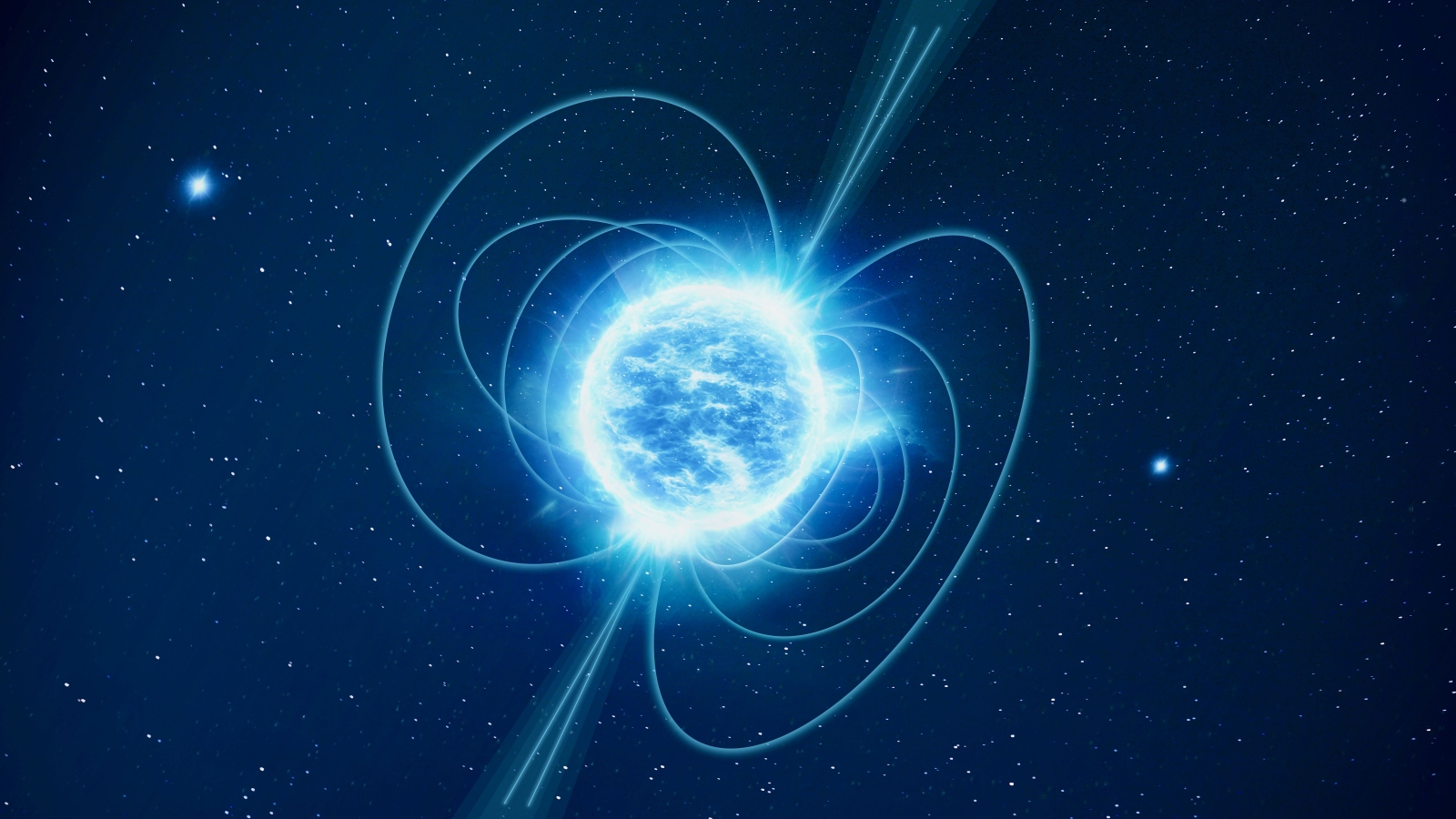
Magnetars provide an extreme setting for studying the coupled evolution of magnetic fields, temperature, and rotation.
What we studied
The crust can be described using electron magnetohydrodynamics with finite electrical conductivity. In this picture, magnetic-field evolution contains two important contributions: Ohmic dissipation, which irreversibly removes magnetic energy, and Hall drift, which redistributes that energy between spatial scales.
The report develops the relevant induction equation, estimates the characteristic physical scales, and reviews how Hall-driven transfer and Joule heating may operate in the highly magnetized crust. It also connects this formalism with questions about pulsars, magnetars, and the long-term thermal and rotational evolution of isolated neutron stars.