Supersonic Turbulence
Energy spectra and fluxes from high-fidelity direct numerical simulations.
This project examines how kinetic energy moves across scales in compressible and supersonic turbulence. We performed $1024^3$ direct numerical simulations spanning turbulent Mach numbers $0.2\leq M_t\leq3.0$, resolving the transition from subsonic eddies to shock-dominated flow.
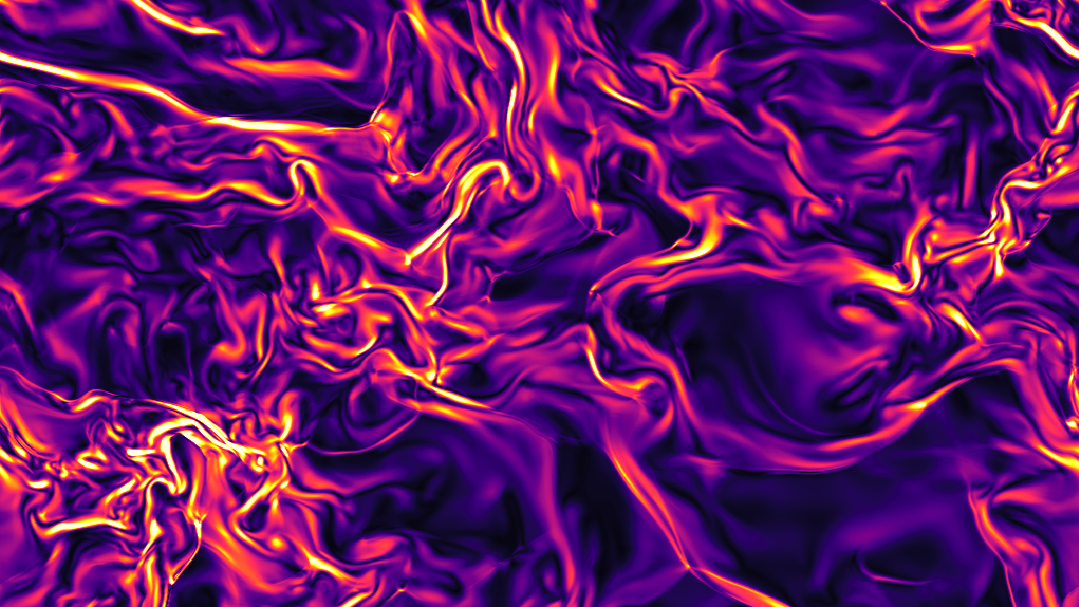
A cross-sectional field from a high-resolution supersonic-turbulence simulation.
What we did
We decomposed velocity into rotational and compressive components,
\[\mathbf{u}=\mathbf{u}^{R}+\mathbf{u}^{C}, \qquad \nabla\!\cdot\!\mathbf{u}^{R}=0, \qquad \nabla\!\times\!\mathbf{u}^{C}=0,\]and measured their spectra, fluxes, cross-transfers, and pressure dilatation scale by scale. With increasing $M_t$, the rotational spectrum steepens from Kolmogorov-like $k^{-5/3}$ toward $k^{-2}$, while the compressive spectrum becomes shallower. The cause is not a single universal cascade: solenoidal-to-compressive transfer becomes strong throughout the inertial range, and pressure dilatation converts compressive kinetic energy into internal energy.
In the supersonic regime, the compressive statistics also approach Burgers-like shock scaling,
\[U_C \approx \frac{\Delta V}{\sqrt{12}}, \qquad \Pi_C \approx \frac{(\Delta V)^3}{12L}.\]These results build a scale-resolved physical picture of strongly compressible turbulence relevant to astrophysical and high-speed flows.